Australian Retail Sector Defies Higher Rates as Spending, Income Growth and Investment Surge
19 October 2026
Australia’s retail property sector has maintained momentum through 2026, underpinned by strong consumer spending, elevated transaction volumes, broadening income growth and stable yields, according to Knight Frank’s latest Australian Retail Review.
The October report found retail investment volumes reached $7.5 billion in the first half of the year, up 12% compared with the same period in 2025, with activity driven by stronger demand from domestic institutional investors, with this group making $1.4 billion in net acquisitions.
Based on closed and pending transactions, volumes in 2026 have the potential to be the highest in a decade, nearing the record high set in 2015.
Activity in Q3 has been strong, with $2.8 billion of closed transactions and $4 billion pending.

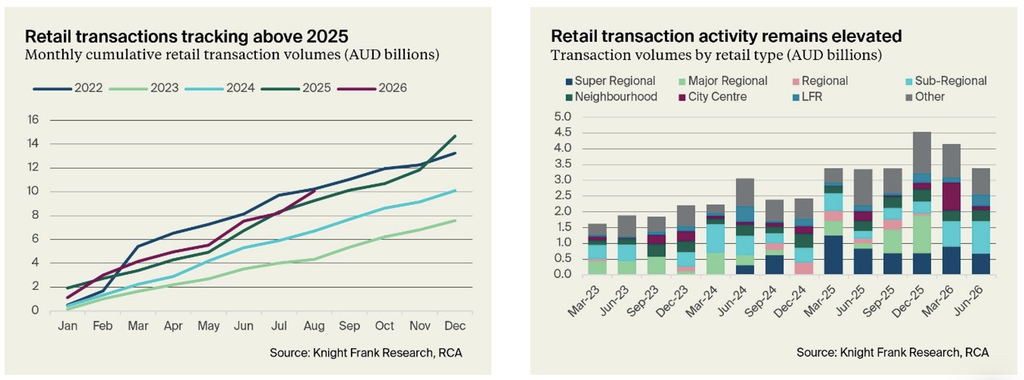
Retail investment activity has been underpinned by strong household spending, which rose 6.8% in the year to August 2026. The strength of consumer spending has translated into improving retailer performance, with average EBIT margins across a selection of major retailers increasing to 8% in the 2025-26 financial year, while leasing fundamentals continued to strengthen as vacancy rates fell to their lowest level in more than a decade.
Retail yields remained stable at 5.6%, highlighting continued investor confidence in the sector despite a higher interest rate environment.
Meanwhile, average retail sector capital values increased by 0.5% in Q2 2026, bringing total capital growth over the past year to 3.7%, the strong annual result since Q4 2017.
Knight Frank Senior Economist, Research & Consulting Alistair Read said the sector had demonstrated remarkable resilience despite a backdrop of higher borrowing costs and renewed inflationary pressures.
“Retail has continued to build on the strong recovery that began in 2025, with consumer spending remaining far more resilient than many expected,” he said.
“Importantly, that spending growth is flowing through to retailer performance, supporting stronger leasing outcomes, ongoing rental growth and improved income prospects for retail investors.”
Across 95 publicly listed retail assets, moving annual turnover growth averaged 3.4% over the past year, while average re-leasing spreads increased to 4.6% as retailers competed for increasingly scarce space. Occupancy costs remained stable at 14.2%, indicating most retailers are comfortably absorbing rent growth.
“Investor appetite for retail remains very strong, as retail assets have continued to perform relatively well over the past year with annual returns of 9.8 per cent,” Mr Read said.
“The combination of resilient consumer spending, limited new supply and improving income growth has reinforced retail’s position as one of the most attractive commercial property sectors for investors.”
While the outlook remains positive, Knight Frank’s Australian Retail Review notes that renewed inflationary pressures and the prospect of additional interest rate rises remain important watchpoints heading into 2027. The impact of a housing market slowdown on discretionary retail categories will also be closely monitored.
Despite these risks, Knight Frank expects the sector’s medium-term fundamentals to remain supportive, particularly given ongoing constraints on new retail development.
“One of the most important themes emerging in the market is the growing recognition that rental growth will be the key driver of performance in a higher-for-longer interest rate environment,” Mr Read said.
“Retail is well positioned in that regard. Limited new supply, strong population growth, low vacancy and healthy tenant demand are creating a favourable environment for sustained income growth.”
The report also highlights several emerging trends shaping the retail sector, including landlords increasingly deploying capital to secure early lease renewals – in some cases several years ahead of expiry – from major and large-format tenants, the reconfiguration of large-format retail space, growing demand for experiential and entertainment uses, and the return of institutional and superannuation capital to the sector.
Related Articles