

Sentiment amongst corporate real estate leaders is cautious but optimistic, according to Knight Frank’s new (Y)OUR SPACE Horizon Report.
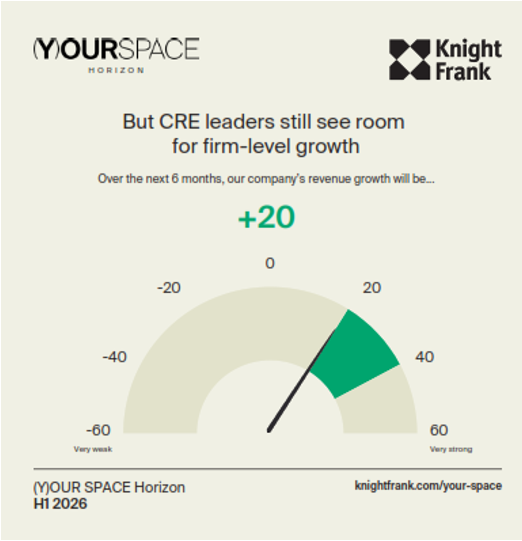
The H1 2026 report provides a half-yearly read on the key issues facing corporate real estate leaders and the underlying sentiment shaping their actions, based on a survey during the first quarter of 2026.
Rather than being retrospective, (Y)OUR SPACE Horizon is a forward-looking instrument – a barometer for how corporate real estate leaders are preparing to navigate the six months immediately ahead of them and which of the big themes shaping 2026 are most likely to gain traction and attention.

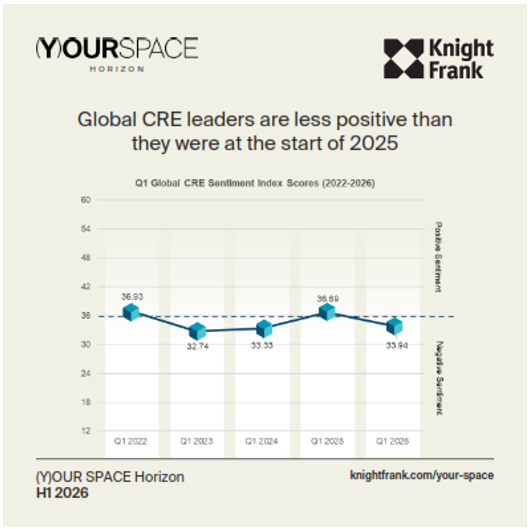
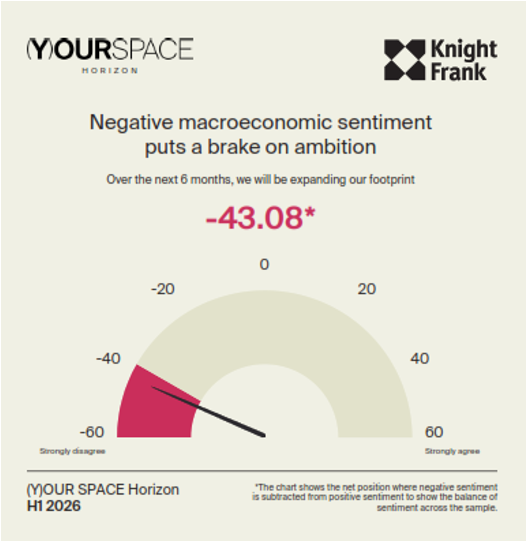
It found global CRE leaders were more cautious than they were at the start of 2025, with Knight Frank’s Global Corporate Real Estate Sentiment Index at 33.94 compared to 36.69, with negative macroeconomic sentiment putting a brake on ambition to expand footprints.
“Corporate real estate (CRE) enters 2026 at a moment defined not by clarity, but by contradiction,” said Tim Armstrong, Knight Frank’s Global Head of Occupier Strategy and Solutions.
“Boards want meaningful and immediate cost savings; at the same time, they want credible acceleration on AI deployment, greater organisational resilience, and tangible progress on securing long-term energy capacity.
“Each of these demands is difficult in isolation. Taken together, they form the paradox that now defines the CRE agenda.
“In 2025, this tension was acknowledged across global markets. In 2026, it must be acted upon – decisively, coherently, and with a new degree of strategic discipline.”
When asked about the big themes in the year ahead, seven in ten CRE leaders believe their organisations can both cut costs now and invest in the real-estate changes required for long-term business transformation.
“That is not soft optimism; it is a form of disciplined confidence,” said Mr Armstrong. “Respondents are fully aware of the volatility surrounding them – from the macroeconomic climate to geopolitical disruptions and intensifying corporate pressure on capital allocation. Yet despite this turbulence, they see a path to act rather than to defer, to reshape rather than retreat.
“In 2026, commercial real estate leaders do not have the luxury of choosing between competing priorities.
“Instead, they will be asked to balance them, integrate them, and most importantly, sequence them into a coherent and investible plan.
“The findings of Knight Frank’s (Y)OUR SPACE Horizon shows that practitioners understand this challenge.
“More importantly, they show a community ready to meet it with clarity, pragmatism and ambition.”
Knight Frank Partner, Head of Global Portfolio Solutions, Australia & New Zealand Jenna Wallace said: “The latest Knight Frank research confirms what many of us are already feeling. Global CRE sentiment has eased.
“But the data has a more nuanced story to tell. Despite the macro headwinds, the focus is to not expand, but upgrade. Not more space, but better space.
“For our clients across the region, that’s exactly the conversation we’re having. In an environment like this, the businesses that move thoughtfully and strategically are the ones that come out ahead.”
Knight Frank Head of Global Portfolio Solutions, APAC Francesco Demarco said: “Our research has now made it clear that the traditional boundaries around corporate real estate have dissolved. Tariff volatility, supply chain redesign, AI deployment, energy security — these are no longer background noise for CRE teams. These are business variables which now directly impact the real estate portfolio and therefore need to now be considered as portfolio design inputs. This is incredibly challenging given the longer-term uncertainty surrounding these variables.
“In our region, trade exposure is acute – even more so than it has been historically – and policy environments shift rapidly. One of the key objectives is to try and implement portfolio resiliency. We are no longer optimising for a single scenario. We are building a portfolio that can absorb disruption — shorter commitments where risk is high, increased investment where fundamentals are strong and talent pools are deep and stable, rethinking capital investment and fit outs, and a deliberate bias toward optionality in every lease structure. These are a few of the ways that we are seeing how disciplined confidence looks in practice.”
To view the full (Y)OUR SPACE Horizon H1 2026 report, visit https://oss.knightfrank.com/knight-frank-your-space-horizon-2026.
Related Articles