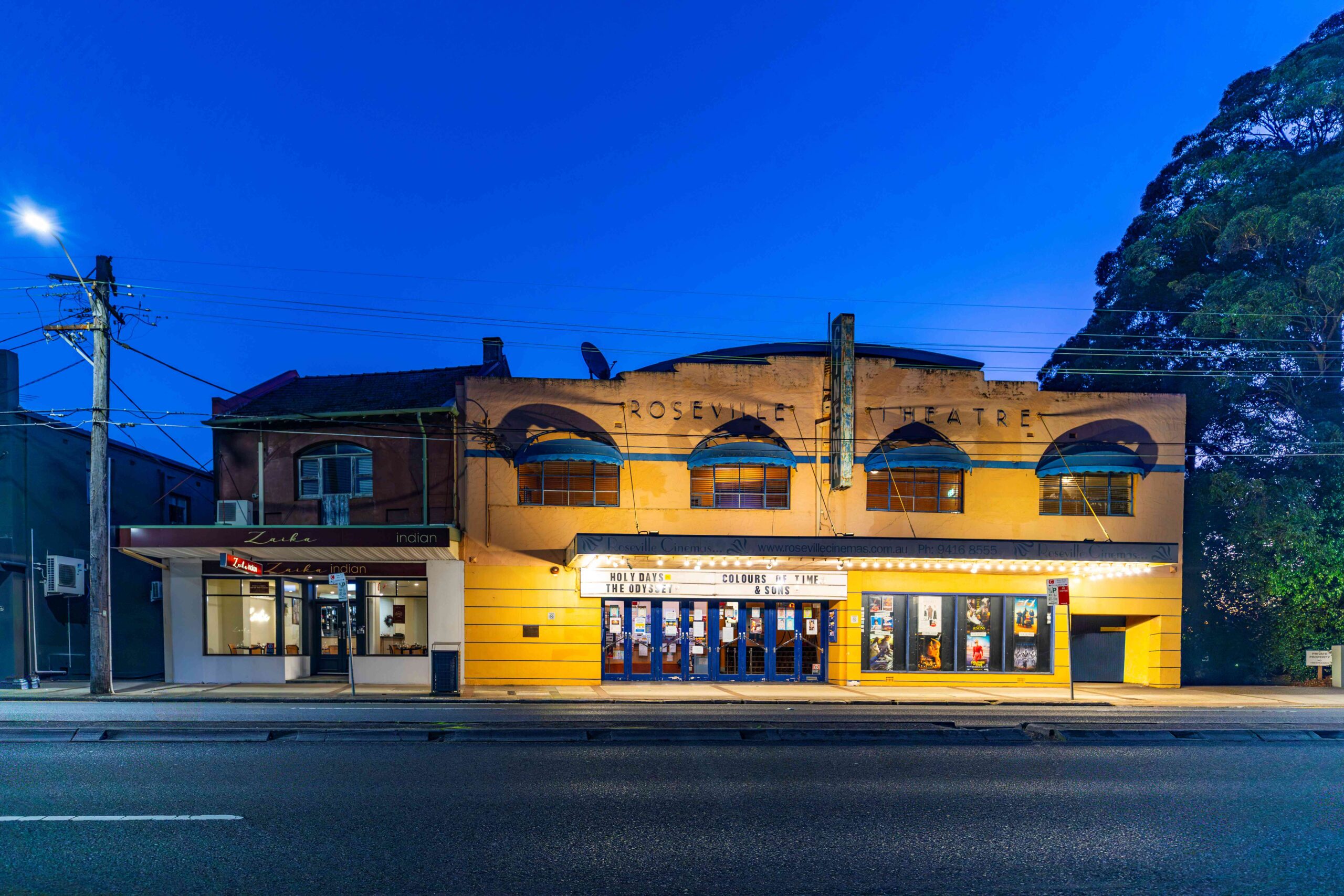
Roseville Cinemas, one of Sydney’s most iconic independent cinemas, will continue operating under its longstanding use following its sale to a renowned cinema operator for more than $8 million.
The landmark North Shore asset at 110-116 Pacific Highway in Roseville was sold following an Expressions of Interest campaign managed by Knight Frank agents Mark Litwin and Joshua Baruch in conjunction with James Sutton of McGrath Lindfield.
The offering comprised the historic cinema complex alongside an adjacent retail, office and residential building on a combined 1,077sq m landholding.

The sale was negotiated on behalf of Michael Brereton of William Buck Australia as court-appointed trustee for the sale of the property, which last changed hands in 1974 when it was purchased by the Van Pinxteren family.
Roseville Cinemas is one of Sydney’s oldest continuously operating independent cinemas and occupies a prominent position directly opposite Roseville Train Station within the suburb’s tightly held village precinct.
The sales campaign attracted strong interest from buyers across New South Wales, Victoria and Queensland, with purchasers assessing a range of opportunities including retaining the existing cinema operation, repositioning the asset and redevelopment outcomes.
Ultimately, the property was acquired by an operator with strong ties to the cinema community, which intends to retain the cinema use, securing the future of one of Sydney’s most recognised independent entertainment venues.
Mr Litwin said the campaign highlighted the depth of demand for strategically located assets that offered a combination of income, development potential and community significance.
“Throughout the campaign we received interest from a broad range of buyers from across the eastern seaboard, each attracted by the property’s exceptional position, scale and long-term flexibility,” he said.
“While there was significant interest from groups considering alternative uses for the site, it is a particularly positive outcome that the property has been acquired by an established cinema operator that recognises the importance of the cinema to the Roseville community and intends to retain its operation.
“Roseville Cinemas holds a unique place in Sydney’s history, having served local residents for generations. The fact that it will continue operating as a cinema ensures this important community asset can remain part of the suburb’s fabric well into the future.”
Mr Sutton said the sale represented an outstanding outcome for both the vendor and locals.
“Roseville Cinema has long been regarded as a local institution, and there was considerable interest from community members throughout the campaign regarding its future,” he said.
“The acquisition and commitment to retaining the cinema use will be welcomed by many residents who have strong personal memories associated with the property.
“It is not often that a landmark asset with such historical significance changes hands, and we are delighted to have achieved an outcome that balances strong commercial value with the preservation of an important community asset.”
Mr Baruch said the transaction demonstrated the continued appeal of landmark assets with genuine scarcity value.
“Opportunities to acquire properties of this nature are exceptionally rare, particularly in affluent and tightly-held locations such as Roseville,” he said.
“The site’s location within Roseville, directly opposite Roseville Train Station and with more than 27 metres of frontage to Pacific Highway, provides exceptional accessibility and exposure.
“The campaign generated strong competition from investors, developers and owner-occupiers, reflecting the broad appeal of an asset that combines a significant landholding, income-generating improvements and a rich local history.”
The Roseville Cinema occupies a unique place in Sydney’s history. Originally constructed in 1912 as Roseville Hall, it served as a community gathering place for concerts, dances and local events. During World War I, the hall became the first Australian centre used to recruit soldiers before evolving into a picture theatre from around 1918-1919. The building was transformed into its distinctive Art Deco style in 1936 and has remained one of the North Shore’s most recognisable landmarks ever since.
Related Articles