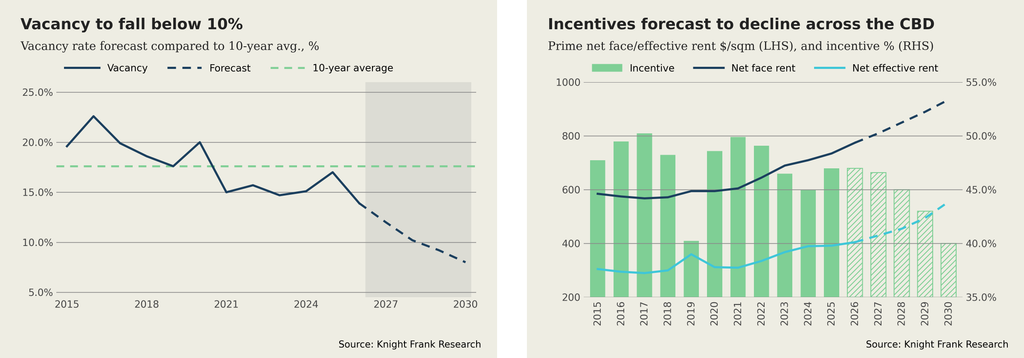
Perth’s CBD office market is entering a period of significant tightening, with vacancy forecast to fall to just 8% by 2030 as strong tenant demand collides with an unprecedented lack of new office supply, according to Knight Frank’s latest Perth CBD Office Market Report.
The Perth CBD vacancy rate fell to 15.4% in the first half of 2026, declining 1.5% over six months following net absorption of 27,528sq m, the second-highest result in the country after Brisbane. Prime vacancy dropped to 13.7%, while net absorption in prime stock accounted for more than 22,000sq m.
Importantly, the vacancy reduction occurred despite no office withdrawals from the market, meaning tenant demand translated directly into lower vacancy levels. At the same time, there were no supply additions and there are currently no new office developments expected to complete before 2030.
Knight Frank Partner, Head of Research & Consulting and report author Dr Tony McGough said Perth’s office market was approaching a pivotal period that would reshape leasing conditions over the remainder of the decade.

“The standout feature of Perth’s office market is the combination of exceptionally strong tenant demand and an effectively non-existent supply pipeline,” he said.
“We recorded more than 27,500sq m of net absorption in the first half of the year, with demand particularly concentrated in higher quality assets, helping drive vacancy rates sharply lower.
“At present, we are not forecasting any meaningful new office supply until 2030.
“Given continued population growth, ongoing business expansion and a healthy level of occupier demand, the market is expected to tighten considerably over the next four years.
“As a result, we forecast vacancy will fall sharply from 15.4% today to around 8% by 2030. That would place Perth among the tightest office markets in the country and create conditions for stronger rental growth as occupiers compete for a shrinking pool of high-quality space.”
The report found Perth’s prime net face rents rose 2.8% over the past 12 months to reach $749/sqm, while stabilising incentives helped drive prime net effective rent growth of 2.4% year-on-year.
Knight Frank forecasts prime net face rents will increase to $935/sqm by 2030, a rise of 4.9% per year, with incentives expected to decline from 47% currently to around 40%.
Knight Frank Head of Tenant Representation WA Alyson Martinovich said occupiers were becoming increasingly aware that today’s leasing conditions may represent the best opportunity before market dynamics shift further in landlords’ favour.
“We’re seeing a high volume of tenant requirements coming to market as organisations look to secure future accommodation while there is still a reasonable level of choice available,” she said.
“There are currently almost 96,000 square metres of active briefs in the market, highlighting the depth of occupier demand across Perth.
“While tenants remain cautious amid broader global economic uncertainty, the reality is that availability, particularly for quality accommodation, is tightening. Businesses that delay their planning may find significantly fewer options available as vacancy continues to decline.
“For larger occupiers seeking premium contiguous space, early engagement with the market and longer-term planning will become increasingly important over the next few years.”
The report also highlights the growing divide between Perth’s leasing fundamentals and its investment market, with office yields softening amid global economic uncertainty despite improving occupier conditions.
Prime yields jumped 32 basis points during the first half of 2026 to 7.9%, the highest level since 2014, while secondary yields softened to 8.95%. However, Knight Frank expects strengthening leasing conditions to support the long-term outlook for investment performance.
Knight Frank Managing Director WA Jeremy Robotham said Perth’s office market fundamentals were strengthening at a time when new development remained financially challenging.
“The Perth office market is benefiting from a rare combination of strong demand, falling vacancy and virtually no incoming supply,” he said.
“While global uncertainty has weighed on investment sentiment and placed upward pressure on yields, the leasing market is telling a very different story.
“With no meaningful supply expected before 2030, competition for quality space will continue to increase, supporting rental growth and improving occupancy across the CBD.
“Further, unlike in larger cities across Australia, Perth does not have significant metropolitan office markets, which means that at some point, growing suburban tenants do not have a lot of choice to support their office footprint expansion other than the CBD.
“As the market tightens and rental growth accelerates, Perth is likely to become increasingly attractive to investors seeking exposure to a market with some of the strongest office leasing fundamentals in Australia. Opportunistic office buyers could be well rewarded.”
The Knight Frank report noted Perth’s population growth remains the strongest of any Australian capital city on a percentage basis since 2010, providing ongoing support for office demand and broader economic activity.
Related Articles