Prominent Greenwich corner site set to be repositioned into alternate residential accommodation
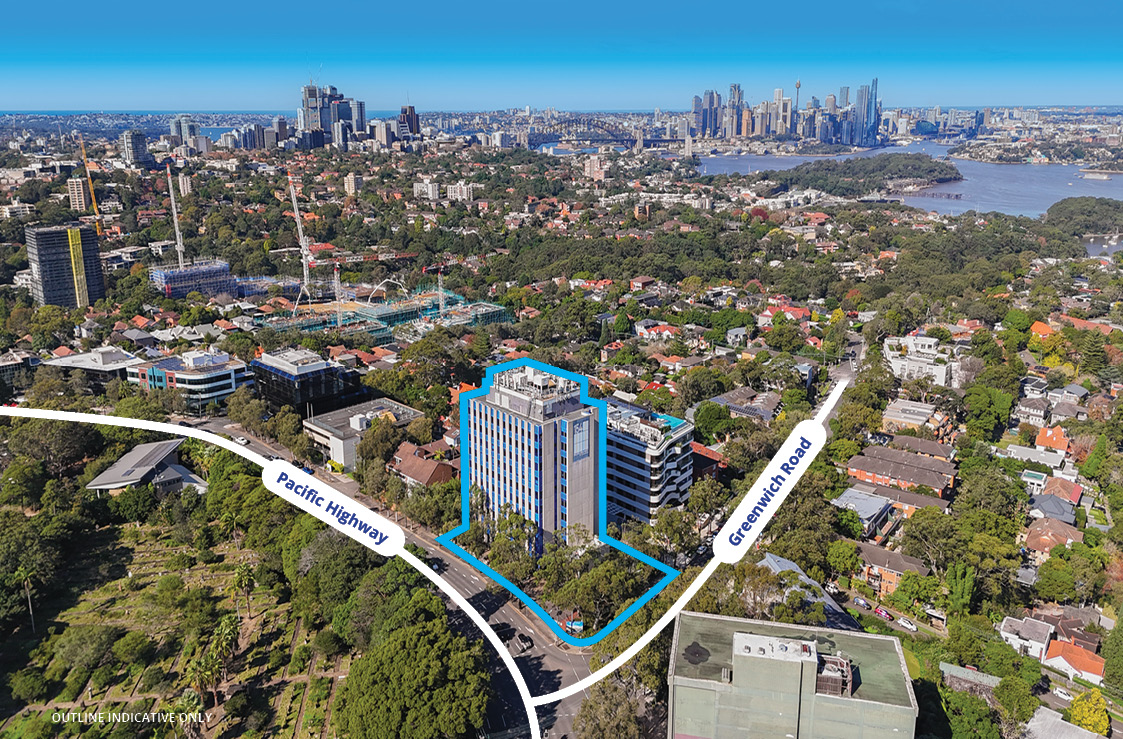
A private property group has secured 154 Pacific Highway in Greenwich, an elevated landmark adaptive reuse opportunity overlooking Sydney Harbour, from Australia’s largest state farming organisation, the NSW Farmers Association. The significant office middle markets asset was transacted by Colliers’ National Directors Tom Appleby, Joseph Lin and Guillaume Volz.
Formerly known as the Johnson & Johnson Building, the 10-storey commercial building occupies a significant 3,080 sqm corner site, currently comprises 6,300 sqm of building area and 182 car spaces, enjoys elevated Harbour views, and benefits from favourable fundamentals including a central core and generous slab-to-slab heights.
Subject to approvals, at least 9,240 sqm of gross floor area could be developed on the site. The existing improvements are currently ~32% below what is permissible, ensuring meaningful scope for repositioning.
Annabel Johnson, CEO NSW Farmers Association, was very happy with outcome, advising, “The sale aligns with the Association’s mandate to redistribute capital into other initiatives that will directly benefit NSW Farmers. We felt the time was right given the recent state government planning reforms.”
Whilst the sale price is subject to a strict confidentiality agreement, it is understood the complicated deal structure may be tied to a future development outcome.
“Office middle market assets with compelling alternate use potential are forecasted to remain hotly contested in 2026. Replacement cost realities have become increasingly valued as construction costs remain historically high. Despite fielding strong interest from medical, religious and education organisations looking to own and occupy, the purchaser’s confidence in their ability to retain the core and reposition the existing asset set them apart. The combination of scale, commanding harbour views, favourable fundamentals including a central core and generous slab-to-slab heights, as well as proximity to infrastructure were highly valued,” Tom Appleby noted.
Related Articles