

Australian commercial property investment activity has remained resilient despite elevated geopolitical uncertainty and interest rates, however investors have pivoted to increasingly target core plus and value-add strategies with higher returns, according to Knight Frank’s latest research.
The firm’s Australian Capital View – September 2026 found Australian transaction volumes rose to $14.3 billion in Q2 2026 from $8.8 billion in the previous quarter, taking total first-half investment activity to just over $23 billion, the strongest H1 result since 2022. Industrial ($5.9 billion) and retail ($3.4 billion) assets drove activity, supported by robust domestic investor demand and growing confidence in longer-term market fundamentals.
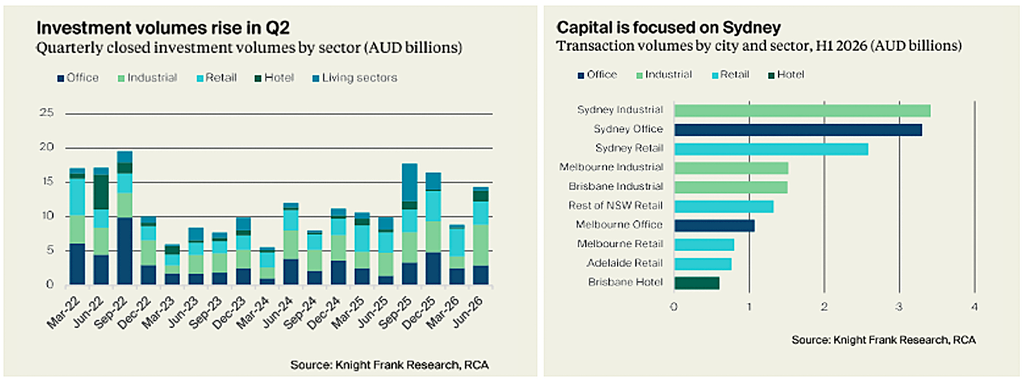
However, the investment landscape is increasingly being shaped by a higher-for-longer interest rate environment, reinforcing the importance of asset selection and rental growth in driving future returns.

Knight Frank Chief Economist Ben Burston said investors had navigated another external shock in 2026, but the higher interest rate environment was clearly shaping strategy.
“While growth is expected to slow, the Australian economy is likely to prove more resilient than many investors anticipated back in March,” he said.
“The rise in inflation and interest rates this year has been far less severe than the inflation and interest rate shock experienced in 2022 and 2023, while households and businesses are entering this period from a much stronger position.
“The key difference for investors is that higher interest rates are likely to persist for longer. That means rental growth, rather than yield compression, will be the primary driver of performance in the near term.
“This places a premium on market segments experiencing strong growth and without the prospect of new supply dampening this momentum.”
Knight Frank Partner, Head of Capital Markets Australia Michael Kwok said investor appetite remained healthy despite continued macroeconomic headwinds and geopolitical uncertainty, with buyers regaining confidence.
“The fact that transaction volumes rebounded so strongly during a period of elevated uncertainty demonstrates that capital remains committed to Australian commercial property,” he said.
“However, investors remain highly selective about capital deployment, focusing mostly on high-quality assets with clear near-term structural tailwinds.
“The preference for many groups now however is to target core plus and value-add strategies rather than core investments with the likelihood of a lower return.
“The higher interest rate environment has resulted in many seeking 10 to 15 per cent returns rather than the typical eight to 10 per cent benchmark for core strategies.
“Investors are also concentrating on sectors and locations where rental growth is being supported by constrained supply.
“We’re seeing strong demand for prime office assets in Sydney and Brisbane CBDs, while industrial investors are focusing on infill locations where supply remains limited.”
Mr Kwok said Australia’s transparency, stability and improving property fundamentals continued to attract both domestic and offshore capital.
“Australian real estate continues to compare favourably on a global basis. As confidence improves and uncertainty recedes, we expect investors to remain active, particularly in sectors benefiting from strong occupier demand and limited new supply,” he said.
The report noted that while further interest rate increases remain a possibility, improving business confidence, resilient consumer spending and strong investment in areas such as data centres are helping support the broader economic outlook heading into 2027.
Related Articles